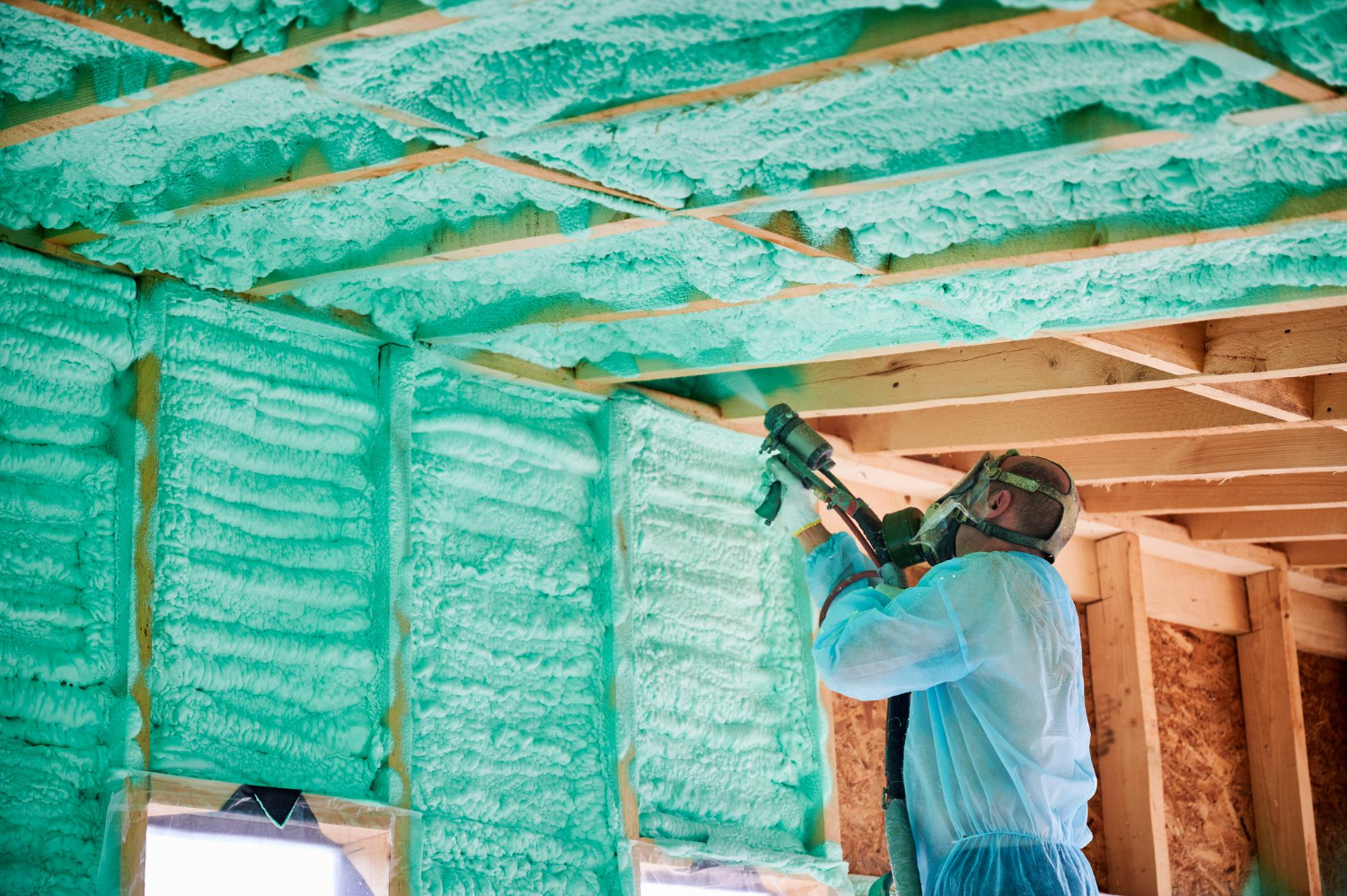
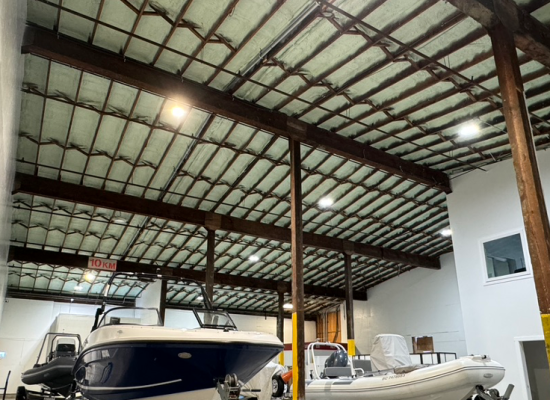
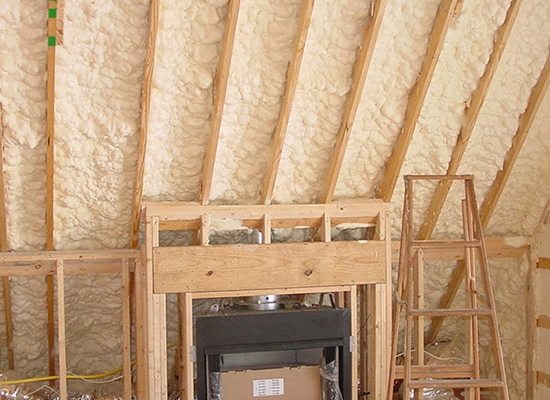
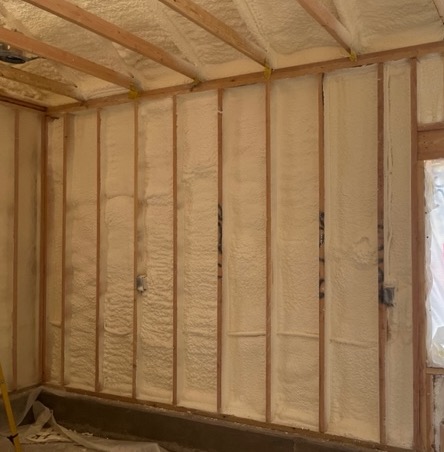
There are two main types of spray polyurethane foam (SPF) insulation, Open-Cell spray foam also known as “low-density” or “0.5lb foam” and Closed-Cell Spray Foam also known as “medium-density” or “2.0lb foam” each with distinct properties, uses, and performance characteristics.
Open-Cell Spray Foam is soft and it has flexible texture after curing. It Expands significantly (up to 100× its liquid volume) with lower density 0.5 lb/ft³.
Open cell spray foam material has excellent air barrier property but not a vapor barrier. Therefore, it is required to be covered or painted with specific vapour barrier paint.
Open cell spray foam has high sound absorption properties and it is great for noise control, it is cost-effective per board foot and it can fill irregular cavities easily, great for insulating joist ends. Open cell foam has lower R-value (~R-3.6 to R-4 per inch) than closed-cell, it allows some moisture vapor permeability (helps walls “breathe”), therefore it is not suitable for high-moisture or exterior environments.
Closed-Cell Spray Foam or “medium-density” or 2.0 lb foam is harder material compare to 0.5lb foam, and it has rigid structure after curing.
Closed-Cell Spray Foam has higher density (~2 lb/ft³), acts as both air and vapor barrier with excellent moisture resistance property and it also provides structural reinforcement to walls or roofs. Closed cell SPF or 2.0lb foam has various applications such as Exterior walls, roofs, basements, crawl spaces, and commercial buildings, cold storage, metal buildings, and high-humidity environments. Closed cell SPF or 2.0lb foam has Higher R-value (~R-6.0 to R-7.2 per inch) with excellent moisture and air sealing performance. 2.0lb SPF has higher material and installation cost with Less sound absorption and it is also more difficult to trim or remove
Other Specialized
Types of SPF
There are other specialized types of SPF (Less Common) but industrially used to some extension such “Roofing Foam” (High-Density, ~3 lb/ft³) which is used for commercial flat roofs. Roofing foam is highly durable and it is great waterproof material. There are also Low-Pressure Kits SPF materials such as cans or low-pressure Portable Units. The low-pressure portable units are suitable for small jobs or touch-ups.
FEATURE
PU Foam Solutions
SPRAY PU FOAM INSULATION
High-performance spray foam solutions for superior insulation, airtightness, and energy efficiency in residential and commercial buildings...
RIGID PU FOAMS
Custom rigid polyurethane foam products engineered for thermal performance, durability, and a wide range of construction applications...
CHEMICAL RECYCLING
Innovative chemical recycling technology that transforms polyurethane foam waste into valuable recycled polyols for new production...
ATTIC & FLAT ROOF
Airtight sealing ability of spray foam insulation is a major advantage compare to other traditional insulation such as fiber glass and blown-in insulation. Spray foam expands into cracks and gaps in the attic floor or roof deck, creating an airtight barrier. It offers superior insulation (high R-value) compared to many traditional materials, it prevents moisture intrusion and reduces risk of mold because it doesn’t absorb water like some older insulation types. Spray foam helps make the attic either conditioned (when insulating under the roof sheathing) or better separated if insulating the attic floor.
Spray foam the roof deck/underside of roof sheathing is the most appropriate design for unvented flat ceiling, below deck balcony where it can separate the cold from the living space below. The right approach depends on your house design, climate, ventilation, and use of the attic. If you spray foam insulate the roof deck and attic, then traditional attic venting may not require to be installed. Proper installation of spray foam is critical to fill gaps, voids and improper curing can reduce performance significantly. So better leave your spray foam insulation of your attic to a professional.
EXTERIOR WALL
For exterior wall closed-cell spray polyurethane foam (2.0 lb/ft³ density) is usually recommended. This medium density closed cell foam acts as air, water, and vapor barrier and provides higher R-value (≈ R-6 to R-7 per inch) than conventional fiber glass batt insulation. It also adds structural rigidity to walls with great adhesion to wood, concrete, and/or any wood sheathing. It is also resistant to moisture intrusion and wind-driven rain. Spray foam insulation is applied between studs on exterior sheathing (OSB or plywood) and must be covered with gypsum board or other fire-rated barrier inside. It can also be sprayed on exterior sheathing before cladding (e.g., stucco, siding).
Spray polyurethane foam (2.0 lb/ft³ density) is one of the most effective materials for insulating and protecting foundation concrete walls (both interior and exterior). Unlike rigid boards, foam is spray-applied directly on the surface of concrete wall, eliminating joints or gaps, prevents thermal bridging, keeping basements warmer and reducing heating costs. Closed-cell SPF creates a monolithic, seamless layer that blocks air leakage through cracks or pores in concrete, prevent moisture vapor diffusion and stop liquid water penetration from outside soils. It helps maintain dry, comfortable basements crucial in humid or cold climates. Spray foam is inert and non-nutrient to microorganisms and by eliminating condensation and moisture, SPF reduces the risk of mold growth on wall surfaces or behind insulation systems.
CRAWL SPACE
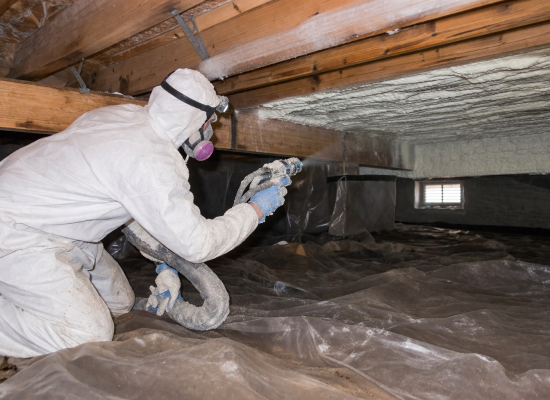
spray polyurethane foam is one of the best materials for insulating and sealing crawl spaces, especially in cold or humid climates like Canada’s West Coast (e.g., Vancouver). Crawl spaces are often uninsulated, damp, and leaky, which leads to heat loss through the floor above, cold floors and uncomfortable rooms, moisture, mold, and mildew problems, infiltration of radon, dust, or odors from the ground. SPF solves all of these issues at once by providing insulation, air sealing, and moisture control in one continuous layer.
ROOFING
High density spray foam (3.0 lb/ft³ density) is formulated and used as particular tight closed-cell polyurethane foam specifically for roofing applications. Its superior strength and closed-cell structure provide a seamless, durable, and watertight barrier for commercial and industrial roofs. The foam’s closed-cell composition prevents water from penetrating into the foam, ensuring a waterproof barrier. This is important for roofing, as damage will not compromise the entire roofing system. At approximately 50% harder than 2 lb foam used for insulation, 3 lb foam is strong enough to withstand foot traffic, weather, and debris. It is applied as a liquid, the foam expands to fill in gaps, cracks, and seams, creating a continuous, monolithic surface that is less vulnerable to leaks. To prevent degradation from sunlight, a UV protective coating is always applied over the foam during a roofing application. When properly maintained and recoated every 15 to 20 years, a spray foam roofing system can last 50 years or more. Due to its exceptional adhesion, spray foam holds up well against wind uplift and severe weather.
FIRE PROOFING
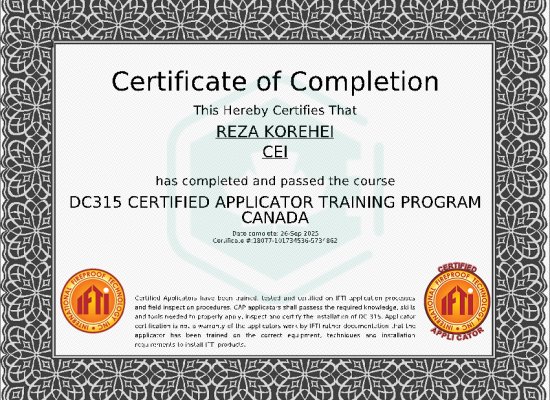
Usually spray foam material are covered by gypsum board or any fire rated plywood. In any cases where spray foam materials cannot be covered by gypsum board then DC315 is a specific intumescent, water-based paint designed for use on spray polyurethane foam to provide a fire-protective thermal or ignition barrier. It is manufactured by International Fireproof Technology Inc. (IFTI) and is intended for interior and unconditioned spaces, such as attics and crawl spaces. We (CEI) are fully licenced by IFTI to properly apply this fire-protective thermal paint (DC315) over spray foam materials. Proper application is critical for DC315 to perform its intended function. The process involves surface preparation, mixing the paint, and applying it according to the manufacturer’s guidelines.
WATER PROOFING
In our waterproofing division, we protect building structures from water ingress, moisture damage, and environmental deterioration by applying high-performance materials tailored to each application. Our comprehensive range of systems covers foundation waterproofing, crawl spaces, podium and plaza decks, swimming pools, wet areas, water-retaining structures, and civil engineering projects. Each solution is engineered to provide a durable, seamless barrier that ensures long-term performance, structural integrity, and reliable protection for both residential and commercial developments.
Our primary objective is to prevent water and moisture from penetrating concrete foundation walls and entering basements or crawl spaces. Because concrete is porous, water can migrate through hairline cracks and capillary pores. To address this, we install waterproofing systems on the positive side (exterior face) of foundation walls, creating a continuous protective barrier. We specialize in spraying 2.0 lb/ft³ density closed-cell polyurethane (PU) foam, which serves as both a waterproofing and insulation system. This approach forms a monolithic, seamless membrane without joints, bonding directly to concrete or masonry surfaces. It delivers an R-value of approximately 6.5 per inch, significantly reducing heat loss through foundations. Typically, the closed-cell spray polyurethane foam (SPF) is applied at 1.5–2 inches thickness and is protected with a coating or drainage board before backfilling.
Additionally, we install post-applied (open-cut) waterproofing systems after the concrete has fully cured. In this method, the concrete surface is thoroughly cleaned and prepared before spray-applied waterproofing membranes are applied. A dimpled drainage membrane is often placed over the waterproofing layer to enhance drainage and protect the system prior to backfilling. These solutions are widely used for foundations, retaining walls, decks, and other exposed structures, providing durable, long-term protection in both new construction and retrofit projects.
Beyond concrete foundation wall waterproofing, we offer specialized solutions for a variety of building structures to prevent water ingress, moisture damage, and environmental deterioration. These include waterproofing for foundation walls, podium decks, water-retaining structures, weather-resistant barriers, and roofs.